
Pricing Ecosystem: Integrations, Process Mining and Partners
By Chris White — PriceBu
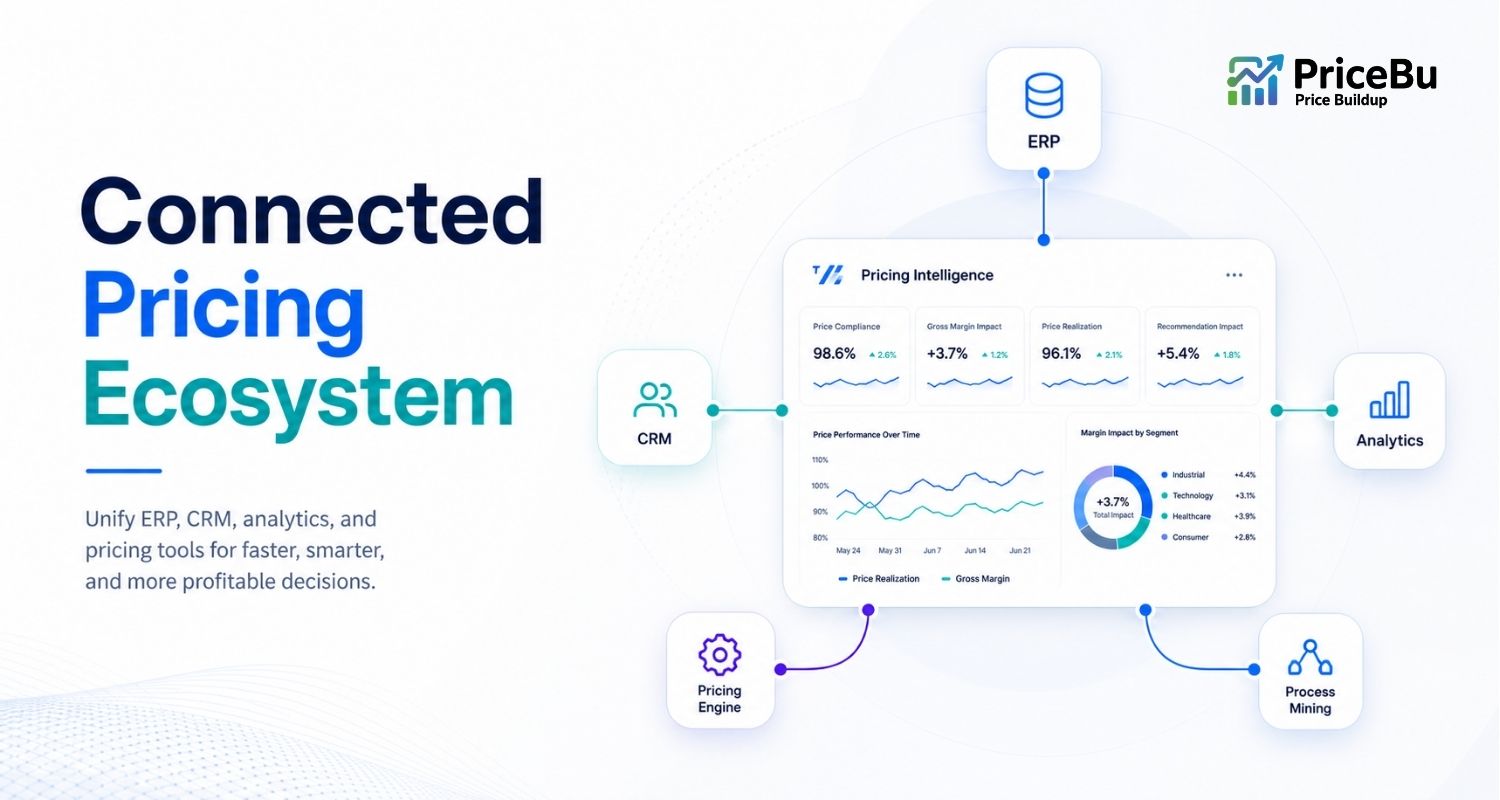
A connected pricing ecosystem integrates ERP, CRM, pricing engines, analytics, and process mining tools to create a unified and automated pricing strategy. By eliminating data silos and manual processes, businesses can improve pricing accuracy, reduce margin leakage, accelerate decision-making, and respond quickly to market changes. Through seamless system integrations and real-time visibility, organizations can optimize commercial performance, strengthen profitability, and build a scalable foundation for long-term growth.
When enterprise leaders look to optimize their commercial margins, they often start by hunting for a standalone tool or a silver-bullet algorithm. They search for a separate piece of software to plug in, hoping it will automatically tell them what their list prices should be.
But pricing in modern B2B and industrial markets doesn't happen in a vacuum. A price is the cumulative output of your entire corporate network. It depends on fluctuating supplier costs inside your ERP, customer tier data tracked in your CRM, external market commodity indexes, and local freight logistics logs.
If your pricing data remains trapped inside isolated software silos, your commercial strategy will always be slow, reactive, and prone to margin leaks. True profitability requires looking beyond single-point applications. By building a connected pricing ecosystem backed by robust system integrations, process mining, and strategic technology partners, businesses can turn fragmented transactional data into a highly synchronized, automated engine for growth.
Introduction: The Fragmented Commercial Landscape
Most mid-market and enterprise industrial companies operate with a deeply fragmented technical landscape. Over years of operational scaling, mergers, and acquisitions, they inherit a patchwork of legacy systems. The finance team lives in one platform, the sales team relies on another, and procurement logs raw material shifts somewhere else entirely.
This disconnect creates a chaotic operational environment. When a major raw material cost spikes, it can take weeks for that data to travel from supply chain logs to the final quoting sheet used by a sales rep in the field. By the time the organization manually updates its price files across various systems, thousands of dollars in margin have already leaked out. Bridging this operational delay is the fundamental reason companies are moving toward a unified ecosystem model.
What Is a Pricing Ecosystem?
A pricing ecosystem is the interconnected network of software applications, data pipelines, automated workflows, and implementation partners that collectively govern how an organization calculates, manages, and executes its commercial strategy.
Rather than treating pricing as a standalone destination, an ecosystem approach views pricing as an active connective tissue. It links your backend financial records directly to your frontend market touchpoints. When built correctly, a change in one corner of your business—such as a logistics cost fluctuation or a customer moving into a higher volume tier—instantly cascades through the loop to adjust pricing guardrails across every digital channel.
Why Businesses Need an Integrated Pricing Ecosystem
Relying on disconnected pricing processes forces an organization to absorb massive, invisible operational taxes. Without a centralized architecture, companies face severe commercial penalties:
- The Spreadsheet Trap: Teams waste hundreds of high-value hours copy-pasting transactional lines across version-controlled spreadsheets to run basic margin audits.
- Severe Margin Leakage: Hidden cost inputs—like off-invoice rebates, split-freight adjustments, or special-order handling fees—are frequently missed during live quoting because they sit in isolated databases.
- Slow Speed-to-Market: Updating global price lists becomes a multi-week administrative marathon rather than a strategic afternoon adjustment.
Core Components of a Modern Pricing Ecosystem
A high-performing, resilient commercial ecosystem relies on five core operational layers working in unison:
- Data Foundation Layer: The transactional bedrock consisting of your core ERP records, customer databases, master product catalogs, and cost accounting matrices.
- Pricing Engine & Analytics Platform: The centralized intelligence center where pricing analysts set baseline rules, establish margin guardrails, and track true historical price realization.
- Integration Middleware: The digital plumbing (such as robust APIs) that ensures data travels seamlessly between systems with absolute security and zero lag.
- Execution & Sales Channels: The customer-facing tools where prices are actually delivered, including enterprise CRMs, dedicated CPQ quoting platforms, and digital e-commerce storefronts.
- The Optimization Loop: Continuous monitoring tools like process mining that track how workflows perform in the real world to find and fix operational bottlenecks.

The Role of System Integrations in Pricing
System integrations are the literal pipelines that keep your commercial strategy from running dry. Without automated integration, even the most advanced pricing logic remains completely useless.
When you integrate your core platforms, you eliminate manual human error and dramatically accelerate commercial responsiveness. For example, a tight integration between your ERP and your pricing engine means your cost-plus formulas always calculate margins using live, actual product costs rather than outdated quarterly averages. Similarly, linking your pricing rules directly to your CRM or CPQ ensures that your sales reps are automatically served compliant target and floor prices directly inside the tools they already use every single day.
Process Mining in Pricing: Unlocking Workflow Visibility
Even with great software, organizations often struggle with compliance. They set corporate discount policies, yet somehow quotes continue to stall in long approval cycles or slip out with unauthorized margins. This is where process mining changes the game.
Process mining is an analytical methodology that extracts digital footprints from your system event logs to reconstruct a transparent, real-time map of your actual pricing workflows. Instead of guessing how long a quote takes to clear, process mining exposes the truth. It uncovers exactly where deals get stuck, which branches are bypassing standard approval guardrails, and where manual interventions are driving up operational costs.

The Importance of Pricing Technology Partners
Building a robust enterprise architecture isn't something you have to tackle completely on your own. Designing an ecosystem that bridges complex industrial data with frontend sales execution requires deep technical specialization. This makes your choice of technology partners critical.
Strategic pricing partners do far more than just install a software package. They understand the nuances of B2B data constraints, design resilient API integrations that won't break your legacy systems, and help configure clean governance workflows tailored to your specific organizational structure. Choosing a platform that values partnership ensures your digital infrastructure is built to scale smoothly for the long haul.
Building a Connected Pricing Workflow
A fully synchronized pricing loop transforms day-to-day operations by removing friction from the commercial process:
First, backend data sources instantly feed raw transactional and cost metrics directly into the centralized pricing hub. Next, pricing analysts track margin health, modify baseline rules, and push updated guardrails without writing a single line of code. From there, the integration layer instantly synchronizes these parameters out to CRM and web channels. Finally, field reps generate highly accurate, compliant quotes in seconds, while live transaction outputs flow right back to the data core to keep the entire cycle loop running continuously.
Common Challenges in Building a Pricing Ecosystem
Transitioning away from isolated, siloed operations naturally comes with clear technical and cultural hurdles:
- The "Dirty Data" Bottleneck: Legacy ERP data is frequently messy, unstructured, or missing critical product attributes, requiring thorough cleaning before systems can sync smoothly.
- Internal User Resistance: Sales teams are often deeply attached to local spreadsheets and manual workaround habits, requiring proactive change management to build long-term trust in the system.
- Integration Complexity: Attempting to build custom, rigid point-to-point connections between legacy systems often leads to brittle technical architecture that is incredibly expensive to maintain.
Best Practices for Successful Pricing Ecosystem Management
- Focus on Standardized APIs: Avoid building highly customized, fragile code loops. Rely on flexible, secure API frameworks to link your pricing engine to external CRMs and ERP systems.
- Clean Data at the Source: Don't try to patch broken data logic inside your pricing engine. Ensure your master product definitions and customer logs are systematically cleaned within the core ERP.
- Audit Workflows Continually: Leverage process analytics regularly to inspect your system flows. If a particular approval tier is continually causing deals to stall out for days, recalibrate the triggers to keep velocity high.
Connected Pricing Ecosystems
As enterprise commerce accelerates, connected architectures are becoming highly dynamic. The future of revenue management belongs to systems that can process shifting market variables on the fly.
Tomorrow's advanced ecosystems will see pricing engines deeply intertwined with real-time operational flows. Supply chain shifts, localized inventory gluts, and competitor price movements will be digested instantly, allowing the system to update floor and target thresholds across global sales networks within minutes. This tight data connection ensures that commercial guardrails adjust dynamically to market realities without requiring constant manual intervention from executive teams.
Business Benefits of a Strong Pricing Ecosystem
When an organization successfully unifies its commercial infrastructure, the strategic rewards extend far beyond simple time savings:

- Elimination of the Spreadsheet Burden: Teams shift from hours of tedious manual data entry to strategic performance monitoring on clean, automated dashboards.
- Absolute Margin Defense: Real-time visibility into the complete price waterfall ensures you catch hidden cost leakages before they erode contract profitability.
- Rapid Speed-to-Market: The business can safely adjust commercial strategy and push updated pricing rules out to thousands of end-points in an afternoon, turning operational responsiveness into a distinct competitive advantage.
How Pricebu Powers Your Connected Pricing Infrastructure
Pricebu is engineered specifically to serve as the unified digital backbone for modern B2B and industrial pricing ecosystems, eliminating operational fragmentation without adding technical complexity.
- Frictionless Enterprise Connectivity: Pricebu centralizes data from disparate legacy databases and ERP records into a single source of truth, removing the chaos of isolated spreadsheets.
- Transparent Governance Engines: The platform streamlines how commercial guardrails travel to the field, enforcing objective rule-based controls that protect margins while speeding up live approval chains.
- Complete Price Realization Visibility: Pricebu strips away the black box of B2B transactions, tracking exact price waterfall performance to ensure your strategic rules translate directly into realized bottom-line profit.
Conclusion: Future-Proofing Commercial Execution
Data is undeniably one of your most valuable corporate assets—but only if it can flow freely to where it is needed most. Relying on disconnected software silos and manual administrative chains to govern thousands of complex B2B transactions is a guaranteed recipe for slow response times and severe margin erosion.
True profitability requires an integrated approach. By uniting your data foundation with a specialized pricing engine, robust workflows, and process transparency, you build a resilient, scalable ecosystem. This connected environment completely removes the guesswork, maximizes your speed-to-market, and ensures that every single commercial transaction actively defends and grows your bottom line.
Ready to eliminate commercial silos and drive profitable execution with a connected pricing infrastructure?